Delicious Romano Chicken with Lemon Garlic Pasta — 5 Secrets for a Perfect Plate
Romano chicken with lemon garlic pasta is the kind of dinner that makes people ask for the recipe before they even finish eating. It combines a golden, cheese-crusted pan-fried chicken cutlet with a silky, bright lemon garlic pasta — and the whole thing comes together in about 35 minutes using ingredients you likely already have.
For more easy and delicious chicken recipes, explore our collection.
If you have ever made a breaded chicken cutlet that turned out soggy, fallen flat, or just plain boring — this recipe solves every one of those problems. The Romano and Parmesan cheese coating creates a crust that is genuinely shatteringly crispy. The lemon garlic pasta sauce is built with cold butter and a splash of cream, giving it that glossy, restaurant-style finish without any complicated technique.
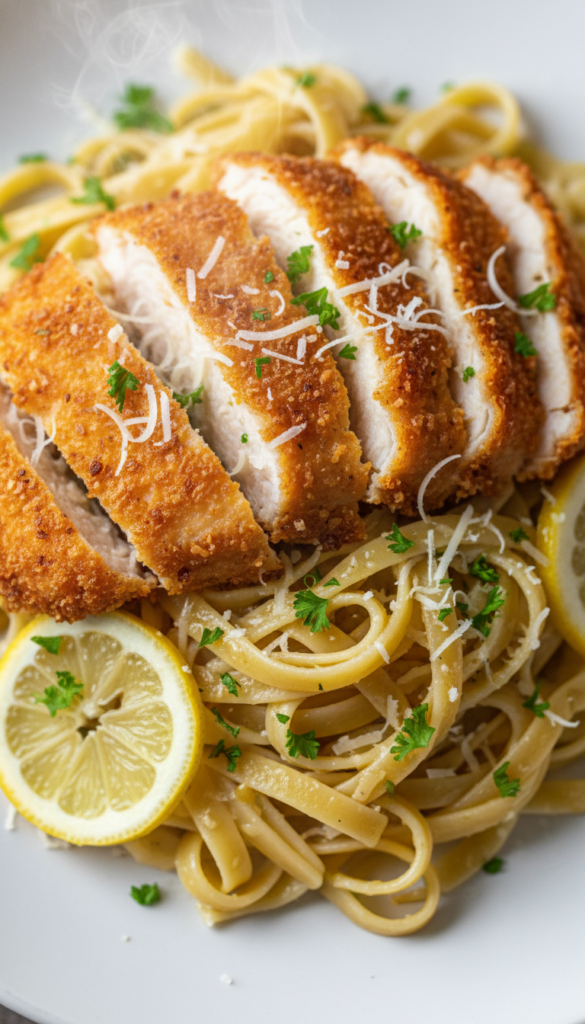
Romano chicken with lemon garlic pasta works as a quick weeknight dinner, a date-night meal, or an impressive dish for guests. The components cook simultaneously, so there is no awkward timing or cold food. This is a one-pan, one-pot meal in the most practical sense.
This recipe guide covers everything: exact measurements, step-by-step instructions, chef-level pro tips, common mistakes, variations, storage, and answers to the most frequently asked questions about Romano chicken with lemon garlic pasta. By the end, you will have complete confidence to make this dish perfectly every single time.
Why This Romano Chicken with Lemon Garlic Pasta Recipe Works
There are many versions of breaded chicken and pasta online. Here is why this specific combination and method produces consistently better results:
- Parmesan and Romano cheese in the first dredge layer adds savory depth and helps create a golden crust that standard breadcrumb-only coatings cannot match
- The three-stage dredging process — cheese, egg, panko — locks in moisture and builds a thick, even crust that stays crispy even after resting
- Panko breadcrumbs are coarser than regular breadcrumbs, which means more surface area for browning and a genuinely crunchy texture on every bite
- Butterflied chicken cutlets cook faster and more evenly than thick whole breasts, eliminating the common problem of raw centers with overcooked exteriors
- Cold butter emulsified into the lemon sauce creates a glossy, restaurant-quality finish that separated, warm butter cannot achieve
- Reserved pasta water contains starch that naturally thickens and binds the lemon garlic pasta sauce to the noodles without making it heavy
- Cooking on low to medium-low heat for the chicken prevents burning the cheese coating before the center is fully cooked
- Lemon zest and lemon juice together deliver layered citrus flavor — the zest brings fragrant oils, the juice brings acidity — making the pasta bright and alive
Ingredients for Romano Chicken with Lemon Garlic Pasta
These are the exact ingredients for 2 servings of Romano chicken with lemon garlic pasta. The recipe scales easily — simply double all quantities for 4 servings.
Romano Chicken Ingredients
1/2 lb (225g) chicken breasts, butterflied or thinly sliced into cutlets
Butterfly the chicken breasts yourself by placing your hand flat on top of the breast and slicing horizontally through the middle, stopping just before you cut all the way through, then opening it flat. Alternatively, ask your butcher to cut them into thin cutlets. Thin, even cutlets are critical for Romano chicken — they cook through quickly before the cheese crust has a chance to burn.
1/2 cup finely grated Parmesan cheese or Romano cheese, for the first dredge
Finely grated is essential here — not shredded, not the pre-grated shelf-stable variety. Finely grated Pecorino Romano or Parmigiano-Reggiano melts and fuses into the coating for a cohesive crust. Pre-grated cheese from a canister is too dry and powdery and will not produce the same golden, flavorful result.
1 large egg, beaten
The beaten egg acts as the adhesive layer between the cheese and the panko breadcrumbs. Beat it well until the white and yolk are fully combined. A pinch of dry parsley stirred into the egg adds color and a subtle herbal note to the Romano chicken coating.
1/2 teaspoon dry parsley, mixed into the beaten egg
1/2 cup panko breadcrumbs (homemade or store-bought)
Panko breadcrumbs are Japanese-style breadcrumbs that are larger, drier, and coarser than traditional Western breadcrumbs. They produce a significantly crunchier, lighter crust on Romano chicken because they create more air pockets during frying. If you only have regular breadcrumbs, use them — but the crust will be denser and less crispy.
Oil for frying: a combination of olive oil and sunflower oil recommended
Using half olive oil and half sunflower oil gives you the flavor depth of olive oil with the higher smoke point of sunflower oil. Pure olive oil alone can burn before the Romano chicken is fully cooked through. Sunflower, grapeseed, or avocado oil all work as the neutral component.
Salt and black pepper to season the chicken cutlets
Lemon Garlic Pasta Ingredients
1/2 lb (225g) linguine or spaghetti or other long pasta
Linguine is the ideal pasta for this lemon garlic pasta sauce because its flat surface clings to the silky butter-cream-lemon sauce better than round pasta. Spaghetti is a very close second. Fettuccine, tagliatelle, or bucatini all work. Avoid short pastas like penne or rigatoni — the sauce gets lost in the tubes instead of coating each strand.
Juice from 1 lemon (about 3 to 4 tablespoons), or to taste
Freshly squeezed lemon juice is non-negotiable in this lemon garlic pasta. Bottled lemon juice lacks the volatile aromatic compounds that make the sauce bright and fresh. Roll the lemon on the counter before juicing to break down the membranes and extract maximum juice.
3 cloves garlic, minced
Freshly minced garlic is essential. Pre-minced jarred garlic has a harsher, more acidic flavor that does not mellow the same way fresh garlic does when it reduces in the lemon juice. Mince it fine so it blends seamlessly into the sauce rather than sitting in chunky pieces.
Zest from 1/4 lemon
Lemon zest contains the essential oils of the lemon skin — the most fragrant, intensely citrusy part of the fruit. Adding zest to the lemon garlic pasta alongside the juice creates a layered lemon flavor rather than just sharp acidity. Use a fine microplane grater and avoid the white pith, which is bitter.
For more easy and delicious chicken recipes, explore our collection.
2 tablespoons cold butter, cut into cubes
Cold butter is the key to the glossy, emulsified lemon garlic pasta sauce. Adding cold butter to a warm (not boiling) pan and swirling rather than stirring allows the fat to emulsify into the sauce rather than separate into greasy puddles. This technique — called mounting with butter or beurre monté — is standard in French and Italian restaurant cooking.
2 to 3 tablespoons whipping cream, or to taste
A small amount of heavy cream stabilizes the lemon garlic pasta sauce and prevents the butter from breaking when the pasta is added and tossed. It also rounds out the sharpness of the lemon juice, making the sauce taste balanced rather than puckering. Do not skip this — it is a small amount with a big impact.
Salt and black pepper to taste
Required Equipment for Romano Chicken with Lemon Garlic Pasta
You do not need specialized equipment for this recipe. These are the only essential tools:
- Large pot for boiling pasta
- Wide skillet or frying pan (10 to 12 inches) for the Romano chicken
- Separate medium skillet or saucepan for the lemon garlic pasta sauce
- Three shallow dishes or plates for the dredging station (cheese, egg, panko)
- Tongs for handling the chicken cutlets
- Fine microplane grater for lemon zest and Parmesan
- Colander for draining pasta
- Measuring cups and spoons
- Sharp chef’s knife and cutting board
Chef’s Tip: Set up your dredging station before you do anything else. Having the cheese, egg, and panko in three separate shallow dishes in a line makes the breading process fast, efficient, and much less messy. Work with one hand for the wet ingredients (egg) and one hand for the dry (cheese and panko) to avoid building up a thick, gummy coating on your fingers.
Step-by-Step Instructions: Romano Chicken with Lemon Garlic Pasta
Part 1: Prepare the Romano Chicken
- Butterfly the chicken breasts or slice them into thin cutlets approximately 1/4 to 1/3 inch thick. If the cutlets are uneven in thickness, place them between two sheets of plastic wrap and gently pound with a meat mallet or heavy skillet until uniform. Even thickness is what guarantees the Romano chicken cooks at the same rate across the entire cutlet.
- Season both sides of each chicken cutlet generously with salt and black pepper. Do not skip this step — seasoning the chicken before dredging is what ensures the meat itself is flavored, not just the crust.
- Set up your three-stage dredging station: Place finely grated Parmesan or Romano cheese in the first shallow dish. In the second dish, beat the egg well and stir in the dry parsley. Place the panko breadcrumbs in the third dish.
- Dredge each seasoned chicken cutlet through the Parmesan cheese first, pressing gently to coat both sides fully. Shake off any excess loose cheese.
- Dip the cheese-coated cutlet into the beaten egg, allowing any excess to drip off for 2 to 3 seconds. Make sure the egg covers every part of the cutlet — this is the adhesive layer for the panko.
- Press the egg-coated cutlet firmly into the panko breadcrumbs, turning and pressing again to coat the second side. Press with your palm to ensure the panko adheres in an even, dense layer. Shake off any loose breadcrumbs. The finished Romano chicken cutlet should have a uniform, dry-looking coating with no wet patches.
- Heat a combination of olive oil and sunflower oil in a wide skillet over medium-low heat. Use enough oil to come about 1/4 inch up the sides of the pan — this is shallow frying, not deep frying. The oil is ready when a few panko crumbs dropped in sizzle gently and steadily without immediately turning dark brown.
- Lay the Romano chicken cutlets carefully into the hot oil, laying them away from you to avoid oil splatter. Do not overcrowd the pan — cook in batches if needed, keeping cooked cutlets warm in a 200°F (95°C) oven on a wire rack.
- Cook the Romano chicken on low to medium-low heat for 4 to 5 minutes on the first side without moving it. You are looking for a deeply golden, evenly browned crust forming on the bottom. Resist the urge to move the chicken — let the crust set and develop.
- Flip each Romano chicken cutlet once. Cook for another 3 to 4 minutes on the second side until equally golden and the internal temperature of the chicken reads 165°F (74°C) on an instant-read thermometer. The crust should be deeply golden, not pale, not dark brown — rich, even golden-brown all over.
- Transfer the cooked Romano chicken to a wire rack (not paper towels — resting on paper towels traps steam and softens the crust). Let it rest for 3 to 5 minutes while you finish the lemon garlic pasta.
For more easy and delicious chicken recipes, explore our collection.
Part 2: Cook the Lemon Garlic Pasta
- Bring a large pot of well-salted water to a rolling boil. The water should taste pleasantly salty — about 1 tablespoon of salt per liter of water. Properly salted pasta water is the first seasoning layer for the entire lemon garlic pasta dish.
- Add the linguine or spaghetti to the boiling water and cook according to the package directions, usually 8 to 11 minutes, until al dente — tender but with a slight resistance when bitten. Before draining, use a ladle or measuring cup to reserve approximately 1/2 cup of the starchy pasta cooking water. This is essential for finishing the lemon garlic pasta sauce.
- While the pasta cooks, begin the lemon garlic pasta sauce. Add the freshly squeezed lemon juice to a medium skillet or saucepan over medium heat. Add the minced garlic, lemon zest, a pinch of salt, and a pinch of black pepper.
- Let the lemon juice and garlic cook together, stirring occasionally, until the liquid reduces by approximately half — about 3 to 4 minutes. The garlic should smell deeply fragrant and the liquid should look slightly syrupy. Reducing the lemon juice concentrates the flavor and removes some of the harsh raw acidity, leaving a mellower, rounder citrus flavor.
- Reduce the heat under the sauce to low. Add one cube of cold butter and swirl the pan in a circular motion — do not stir with a spoon — until the butter melts completely and emulsifies into the sauce. Add the second cube of cold butter and repeat, swirling until fully incorporated. The sauce should look glossy and slightly thickened, not greasy or separated.
- Stir in the whipping cream and 2 tablespoons of the reserved pasta water. The sauce will loosen slightly and look silky. If it seems too thick, add another splash of pasta water. If too thin, let it simmer for another 30 to 60 seconds.
- Drain the cooked pasta (if you have not already) and add it directly to the lemon garlic pasta sauce. Toss vigorously with tongs for 60 to 90 seconds until every strand is evenly coated and the sauce clings to the pasta rather than pooling at the bottom of the pan. If the sauce seems dry, add the remaining pasta water a tablespoon at a time.
- Taste and adjust: more lemon juice for brightness, more salt for depth, more cream to round out acidity, more pasta water to loosen.
Part 3: Plating Romano Chicken with Lemon Garlic Pasta
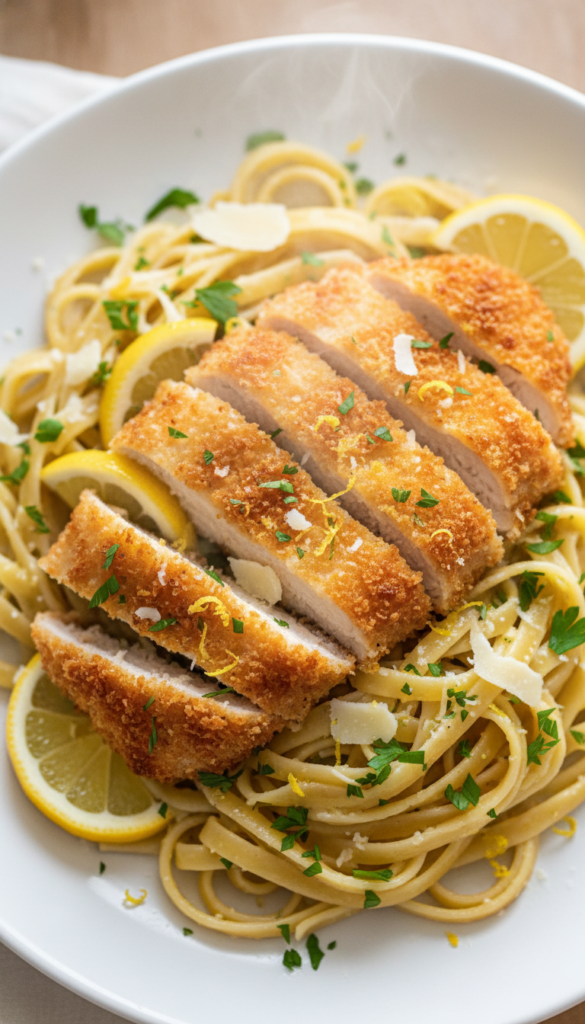
- Twirl a generous portion of lemon garlic pasta into a deep bowl or onto a wide plate using tongs, creating a nest or a mounded pile.
- Place one or two Romano chicken cutlets alongside or slightly overlapping the lemon garlic pasta.
- Finish with freshly cracked black pepper, a few shavings of Parmesan, freshly chopped parsley, and a thin slice of lemon on the rim of the plate.
- Serve Romano chicken with lemon garlic pasta immediately for the crispiest crust and the freshest sauce.
Chef Christie Lai’s 5 Pro Tips for Perfect Romano Chicken with Lemon Garlic Pasta
1. Keep the heat low when frying Romano chicken. The number one mistake is cooking on too high a heat — the panko breadcrumbs brown and even burn before the chicken inside is cooked through. Low to medium-low heat gives the chicken time to cook gently while the cheese-panko crust turns a perfect, deep golden color.
2. Always use cold butter for the lemon garlic pasta sauce. Cold butter emulsifies into the warm lemon juice to create a smooth, glossy sauce. Room-temperature or melted butter will separate into greasy droplets. Take the butter straight from the refrigerator and add it in small cubes, one at a time, swirling the pan between each addition.
3. Reserve the pasta water before draining. The starchy pasta water is your most powerful tool for adjusting the lemon garlic pasta sauce consistency. It also helps the sauce cling to the noodles rather than dripping off. Keep the full 1/2 cup reserved — you can always add more but you cannot add water back once you have drained it.
4. Do not skip the lemon zest. Zest contains the fragrant essential oils from the lemon skin — not the acidic juice. Using zest together with juice gives the lemon garlic pasta two completely different dimensions of lemon flavor: aromatic and acidic. Just zest, and you get perfume with no zing. Just juice, and you get tartness with no fragrance. Both together are what makes this sauce taste layered and complex.
5. Rest the Romano chicken on a wire rack, never on paper towels. Paper towels trap the steam rising from the hot crust and turn it soggy within minutes. A wire rack allows air to circulate on all sides of the Romano chicken cutlet, keeping the bottom as crispy as the top even after resting.
Common Mistakes to Avoid When Making Romano Chicken with Lemon Garlic Pasta
Using Pre-Shredded or Canister Parmesan
Pre-shredded Parmesan does not adhere to the chicken surface the way finely grated fresh cheese does. The dredge layer will be uneven and loose, and the crust will lack the golden, cohesive character that makes Romano chicken so distinctive. Always grate from a block using a microplane or the fine side of a box grater.
Slicing the Chicken Too Thick
Thick chicken cutlets require longer cooking time, which means the cheese-panko crust will overcook and turn dark before the center reaches a safe temperature. Aim for cutlets between 1/4 and 1/3 inch thick. If you are unsure, pound them thinner — it takes 30 seconds and makes an enormous difference.
Cooking the Romano Chicken on High Heat
High heat is the enemy of a perfectly golden Romano chicken crust. The outside will turn brown or burn within 2 minutes, leaving the chicken raw inside. Use medium-low heat and be patient — the 4 to 5 minute cook time per side produces a perfect result.
Not Reducing the Lemon Juice Before Adding Butter
Adding butter directly to cold, raw lemon juice skips the flavor development step. Cooking the lemon juice and garlic together until reduced by half mellows the sharp acidity, concentrates the garlic flavor, and creates a proper sauce base. Skipping this results in a thin, harshly acidic lemon garlic pasta sauce that overpowers everything.
Using Warm or Melted Butter Instead of Cold
Warm butter cannot emulsify. It will simply melt into the lemon juice and sit as a greasy layer on top of the pasta. Cold butter, added gradually with the heat low and the pan swirled constantly, creates the silky, cohesive sauce that makes this lemon garlic pasta so appealing.
Forgetting to Reserve Pasta Water
Once you drain the pasta, the pasta water is gone. It is easy to forget in the rush of cooking, but starchy pasta water is what allows you to adjust the lemon garlic pasta sauce consistency and helps it cling to the noodles. Set a visual reminder — place your measuring cup in the colander before cooking so you physically cannot forget.
For more easy and delicious chicken recipes, explore our collection.
Serving Immediately Without Resting the Chicken
Romano chicken cutlets benefit from 3 to 5 minutes of resting on a wire rack after frying. During this time, the internal juices redistribute throughout the meat. Cutting into Romano chicken immediately after cooking will cause the juices to run out onto the plate, leaving the meat drier than it could be.
Variations & Substitutions for Romano Chicken with Lemon Garlic Pasta
Protein Substitutions
- Chicken thighs: Pound thin for faster, even cooking. The higher fat content gives even more juicy results inside the Romano crust.
- Pork cutlets (schnitzel-style): Works beautifully with the same three-stage dredge. Use pork loin cutlets pounded to 1/4 inch.
- Veal cutlets: The classic Italian-American choice for a Parmesan-crusted cutlet. Follow the identical method.
- Fish fillets: Tilapia, cod, or flounder work well. Reduce cook time to 2 to 3 minutes per side. The crust will be slightly more delicate.
- Eggplant (vegan): Slice eggplant 1/2 inch thick, salt and press for 20 minutes, then use the same dredge with a flax egg (1 tablespoon ground flax + 3 tablespoons water) in place of the egg.
Cheese Substitutions
- Pecorino Romano: Sharper and saltier than Parmesan — delivers a more intense, tangy Romano chicken crust.
- Grana Padano: Milder and less expensive than Parmigiano-Reggiano, but produces an excellent crust.
- Asiago: Slightly nuttier flavor, works well in the dredge layer.
- Dairy-free Parmesan: Nutritional yeast blended with cashew flour produces a vegan-friendly coating that still crisps well.
Breadcrumb Substitutions
- Regular dried breadcrumbs: Use the same quantity. The crust will be denser and less airy than panko but still flavorful.
- Gluten-free panko: Available at most large supermarkets. Swap 1:1 for a celiac-friendly Romano chicken.
- Crushed cornflakes: Gives an extra-crunchy, slightly sweet crust with good golden color.
- Almond flour: Produces a low-carb, keto-friendly Romano chicken crust. Use the same quantity.
Pasta Substitutions
- Spaghetti: The most classic substitute for linguine. Works identically in the lemon garlic pasta sauce.
- Fettuccine or tagliatelle: Wider flat noodles that hold the sauce exceptionally well.
- Angel hair (capellini): Cooks in 2 to 3 minutes. Perfect for an ultra-quick weeknight lemon garlic pasta.
- Gluten-free pasta: Rice-based or chickpea pasta work well. Slightly reduce cook time and check texture frequently.
- Zucchini noodles (zoodles): For a low-carb option. Do not boil — simply sauté in the lemon garlic sauce for 2 minutes.
Lemon Garlic Pasta Sauce Variations
- Add capers for a briny, piquant contrast to the lemon garlic pasta sauce.
- Stir in 1/4 cup dry white wine before the lemon juice for extra depth.
- Add 1/4 teaspoon red pepper flakes with the garlic for heat.
- Finish with fresh basil or fresh thyme instead of parsley.
- Add a handful of baby spinach or arugula to the pasta at the very end — the residual heat wilts it perfectly.
- Swap heavy cream for crème fraîche for a slightly tangy, richer sauce.
Dairy-Free Version
Replace butter with a high-quality vegan butter (Miyoko’s or Earth Balance work well). Replace whipping cream with full-fat coconut cream or a barista-style oat milk. Skip the Parmesan in the dredge and use a combination of nutritional yeast and almond flour. The Romano chicken with lemon garlic pasta can be made fully dairy-free without sacrificing the core flavor profile.
Storage & Reheating: Romano Chicken with Lemon Garlic Pasta
Storing the Romano Chicken
Store leftover Romano chicken cutlets separately from the lemon garlic pasta in an airtight container in the refrigerator for up to 3 days. Storing them separately prevents the pasta moisture from softening the chicken crust. Romano chicken also freezes well — layer the cutlets between parchment paper sheets in a freezer-safe bag for up to 2 months.
Storing the Lemon Garlic Pasta
Store leftover lemon garlic pasta in an airtight container in the refrigerator for up to 3 days. The pasta will absorb the sauce as it sits — this is normal. A splash of water or chicken broth when reheating will bring the sauce back.
Reheating Romano Chicken (Best Method: Oven)
- Preheat your oven to 375°F (190°C).
- Place the Romano chicken cutlets on a wire rack set over a baking sheet.
- Bake for 10 to 12 minutes until the crust is re-crisped and the interior is heated through.
- Do not reheat Romano chicken in the microwave — the crust will turn soggy and soft within seconds.
Reheating Romano Chicken (Quick Method: Air Fryer)
- Preheat air fryer to 350°F (175°C).
- Cook the Romano chicken cutlets for 4 to 5 minutes until crispy and heated through.
- This is the fastest method for restoring the crust to near-original crispiness.
Reheating the Lemon Garlic Pasta
- Add the pasta to a small saucepan with 2 to 3 tablespoons of water or chicken broth.
- Heat over medium-low, tossing frequently, until warmed through and the sauce is reconstituted.
- Add a small knob of cold butter and toss to re-emulsify the sauce if needed.
- Taste and adjust seasoning before serving.
Serving Suggestions for Romano Chicken with Lemon Garlic Pasta
Romano chicken with lemon garlic pasta is a complete, satisfying main course on its own. These sides and accompaniments will round out the meal beautifully:
Fresh Salads
- Arugula salad with shaved Parmesan, lemon vinaigrette, and toasted pine nuts — the peppery arugula contrasts the richness of the Romano chicken perfectly
- Simple Caesar salad — a classic pairing that complements the Italian-American flavor profile
- Caprese salad with fresh mozzarella, tomatoes, basil, and a drizzle of balsamic glaze
Vegetables
- Roasted asparagus with garlic and lemon — echoes the lemon garlic pasta flavors while adding greenery
- Sautéed broccolini with olive oil, garlic, and red pepper flakes
- Roasted cherry tomatoes — their sweetness and acidity cut beautifully through the richness of the Romano chicken crust
- Steamed or sautéed green beans with toasted almonds
- Garlic-sautéed spinach with a squeeze of fresh lemon
Bread
- Crusty garlic ciabatta for mopping up the lemon garlic pasta sauce
- Warm focaccia with rosemary and sea salt
- Simple toasted baguette slices with unsalted butter
Wine Pairings
- Pinot Grigio: Light, crisp, and citrusy — the ideal Italian white wine with Romano chicken with lemon garlic pasta
- Sauvignon Blanc: Bright acidity that mirrors the lemon in the pasta sauce
- Chardonnay (unoaked): Creamy enough to match the butter sauce without overpowering it
- Vermentino: An Italian white with herbal notes that pairs naturally with the lemon garlic pasta
Nutrition Estimate Per Serving — Romano Chicken with Lemon Garlic Pasta
The following values are approximate estimates for 1 of 2 servings. Actual values will vary depending on exact ingredient brands, amount of oil absorbed during frying, and any substitutions made.
| Nutrient | Amount Per Serving |
| Calories | ~720 kcal |
| Protein | ~42g |
| Carbohydrates | ~68g |
| Fat | ~26g |
| Saturated Fat | ~9g |
| Fiber | ~3g |
| Sodium | ~760mg |
| Sugar | ~4g |
| Calcium | ~280mg |
To reduce calories: use an air fryer instead of pan-frying the Romano chicken (reduces oil absorption by approximately 30%), use half-and-half in place of whipping cream, and reduce butter to 1 tablespoon total in the lemon garlic pasta sauce.
Frequently Asked Questions: Romano Chicken with Lemon Garlic Pasta
What is Romano chicken?
Romano chicken is a breaded chicken cutlet coated in Pecorino Romano or Parmesan cheese, egg, and breadcrumbs, then pan-fried until golden and crispy. The cheese coating distinguishes it from standard breaded chicken — it creates a savory, slightly nutty crust that regular breadcrumbs alone cannot replicate. Romano chicken is an Italian-American dish found in restaurants throughout the northeastern United States and is closely related to chicken Milanese and chicken Parmigiana.
Can I bake the Romano chicken instead of frying?
Yes. To bake Romano chicken, preheat your oven to 425°F (220°C). Place the breaded cutlets on a wire rack set over a lined baking sheet. Drizzle or spray lightly with oil. Bake for 16 to 20 minutes, flipping halfway through, until golden and cooked to 165°F (74°C) internally. The crust will not be quite as deeply golden as pan-fried Romano chicken, but it will be satisfyingly crispy and significantly lower in fat.
Can I air fry the Romano chicken?
Yes — air frying produces excellent Romano chicken with a genuinely crispy crust. Preheat your air fryer to 400°F (200°C). Spray the basket and both sides of the breaded cutlets with oil. Air fry for 8 to 10 minutes, flipping once at the halfway mark, until deeply golden and cooked through. Air-fried Romano chicken is lower in fat than the pan-fried version with minimal difference in texture.
What is the difference between Romano cheese and Parmesan?
Pecorino Romano is made from sheep’s milk and has a sharper, saltier, more pungent flavor than Parmesan. Parmigiano-Reggiano is made from cow’s milk and has a nuttier, more complex, slightly milder flavor. Both work in Romano chicken — use Romano for a bolder, saltier crust, or Parmesan for a more subtle, nutty one. Many chefs blend both for a balanced result.
Why does the breading fall off my Romano chicken?
Breading falls off Romano chicken for three common reasons. First, not pressing the panko firmly enough into the egg coating — press with your palm, not just your fingertips. Second, moving the chicken too early in the pan before the crust sets — leave it undisturbed for the full 4 to 5 minutes. Third, too much moisture on the chicken surface before dredging — pat the cutlets completely dry with paper towels before seasoning and dredging.
How do I make the lemon garlic pasta sauce less acidic?
If the lemon garlic pasta sauce tastes too sharp, add a small amount of honey (1/4 teaspoon) or a pinch of sugar to balance the acidity. Adding more butter and cream will also round out sharpness. Cooking the lemon juice for longer before adding butter concentrates and mellows the acid. Finally, taste and add salt — proper seasoning dramatically reduces the perception of acidity.
Can I make Romano chicken with lemon garlic pasta ahead of time?
The lemon garlic pasta sauce can be made up to 2 days ahead and stored in the refrigerator. Reheat gently over low heat with a splash of water or broth before tossing with freshly cooked pasta. The Romano chicken is best made fresh for maximum crust crispiness, but breaded uncooked cutlets can be prepared and refrigerated on a lined baking sheet, covered, for up to 4 hours before frying. Do not freeze breaded uncooked chicken as the egg coating becomes watery when thawed.
What pasta shape works best with lemon garlic pasta sauce?
Long, flat pasta shapes work best with lemon garlic pasta sauce because their surface area grabs and holds the thin, silky sauce. Linguine is the top choice, followed by spaghetti, fettuccine, and tagliatelle. Avoid short pastas like penne, rigatoni, or fusilli for this specific sauce — the sauce is too light to pool in the tubes and coat short shapes effectively.
More Italian-American Chicken Recipes You Will Love
- Chicken Milanese with Arugula Tomato Salad — the original Italian version of a breaded cutlet
- Chicken Piccata with Capers — thin cutlets in a tangy lemon butter caper sauce
- Chicken Marsala — pan-seared chicken in a rich Marsala wine and mushroom sauce
- Chicken Francese — egg-dipped (not breaded) chicken in a light lemon butter sauce
- Baked Chicken Parmesan — Romano chicken topped with marinara and melted mozzarella
Conclusion
Romano chicken with lemon garlic pasta is the rare recipe that delivers restaurant-quality results with weeknight-friendly effort. The crispy Parmesan-Romano crust, the bright lemon garlic pasta sauce, and the contrast of textures on the plate make this a dish that genuinely impresses — whether you are cooking for yourself, your family, or guests.
The keys are simple: thin cutlets, a proper three-stage dredge, patient low-heat frying, cold butter in the sauce, and reserved pasta water for finishing. Master these fundamentals and Romano chicken with lemon garlic pasta becomes a dish you can make from memory, confidently, every time.
This recipe is endlessly adaptable — try it with different proteins, different pasta shapes, and different herb finishes. But the core of Romano chicken with lemon garlic pasta is one of the most satisfying flavor combinations in Italian-American cooking, and once you taste it fresh from the pan, you will understand why it never goes out of style.
RecipesbyFlowen.com
Follow me on Pinterest for more delicious recipes.